Parliamentaty Women’s Climate Congress
The purpose of the Parliamentary Women’s Climate Congress (PWCC) is simple: to create a constructive, cross-party space where women parliamentarians can explore how climate policy intersects with issues that disproportionately affect women, families and communities — and how to ensure policy responses incorporate women’s prioirites and lived experience, are coherent across climate and gender policies, evidence-based and future-focused.
Reports and summaries
WCC papers
FORMATION OF A PARLIAMENTARY WOMEN’S CLIMATE CONGRESS: A call to create the world’s first national parliamentary women’s group on climate action, Women’s Climate Congress, October 2025
Bridging the Gap: Gender-responsive climate policy in Australia, Women’s Climate Congress, March 2026
Gender, climate and the missing link in Australian policy, Women’s Climate Congreee, June 2026
International
Belém Gender Action Plan, UN Framework Convention on Climate Change, 2026
A nine-year international framework adopted by 195 countries at COP30 in Belém, Brazil, to integrate gender equality into global climate policy from 2026 to 2034
Article | Full Plan | WCC Summary
Previous consultation with women on environmental issues (ahead of the Rio Earth Summit, 1992)
Consultation with Women, Office for the Status of Women, 1991-92
Research
Parliamentary Library research commissioned at a PWCC forum in November 2025 has given us a helpful starting point. Australia has made strong international commitments to gender-responsive climate action under the UNFCCC and the Paris Agreement. We reference gender in our Nationally Determined Contributions and in international climate finance reporting. Domestically, however, the picture is more fragmented. Gender is acknowledged in some national documents — including the National Climate Risk Assessment and parts of our health and workforce strategies — but it is not yet systematically embedded across climate policy design, consultation and reporting. This is not a partisan issue. It’s a governance and implementation question.
We know climate impacts are unevenly distributed. We know risk, vulnerability and adaptive capacity vary by geography, occupation, income and gender. We also know that better policy design reduces long-term cost and improves resilience. The opportunity for a multiparty women’s parliamentary group is to:
Support coherence between climate and gender strategies
Encourage better data and transparency
Strengthen consultation practices
Promote women’s leadership in climate decision-making
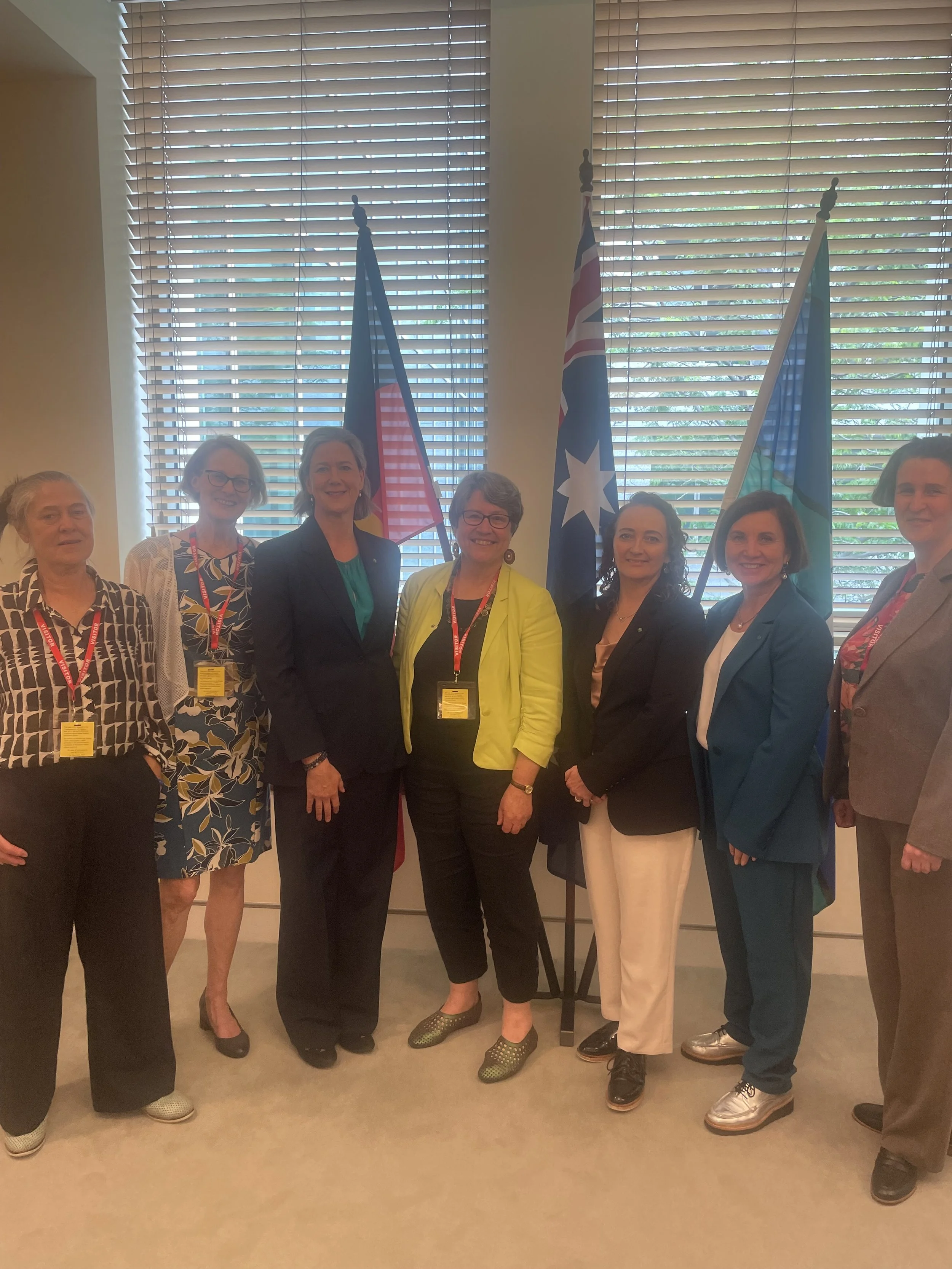
Some participants at PWCC forum, November 2025
L-R: Laurann Yen, Alex Marsden, Nicolette Boele MP, Janet Salisbury, Mary Doyle MP, Jodie Belyea MP, Helen Daley-Fisher OAM.