
Women’s Climate Conversations online
Our very popular Women’s Climate Conversations online series brings together women from diverse backgrounds in online conversations with WCC Founder Dr Janet Salisbury and other WCC members. In these events we discuss aspects of the WCC vision, values and commitments in the light of initiatives and insights from women from diverse backgrounds and disciplines.
Participants have been struck by the inclusivity of these conversations as we bring together women to share insights on the interconnected factors affecting women and Earth. Feedback from participants suggest what we offer is unique and captures a form of deep listening rarely seen elsewhere.
See also our ‘Other events’ page for other events and activities, including those hosted in collaboration with other organisations.
At the end of August/early September we were pleased to present two diffefent but connected topics in the cimate action, gender justice and just transition puzzle. Scroll below to check them out.
Check out our 2026 winter double bill
Beyond the Fossil Fuel Deadlock
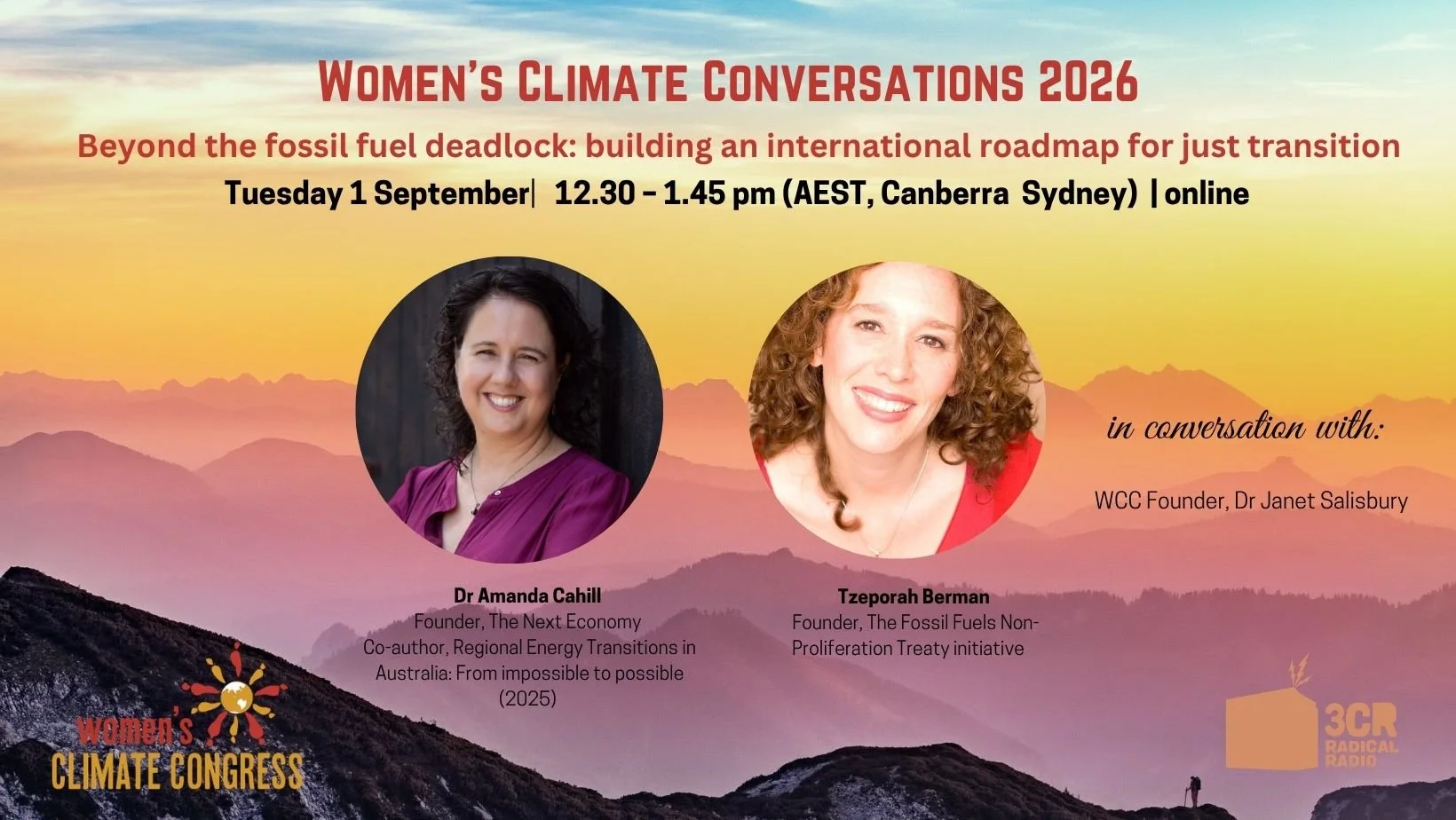
Building an international roadmap for a just transition
Tuesday 1 September 2026
12.30 - 1.45 pm AEST (Sydney, Canberra, Melbourne)
Meet our conversationalists …
Tzeporah Berman is the Co-founder and International Program Director at Stand.earth, the Founder and Steering Committee Chair of the Fossil Fuel Non-Proliferation TreatyInitiative, and a member of the Advisory Group for InfluenceMap. She is the former co-director of Greenpeace International’s Climate Energy Program, the Co-founder of ForestEthics and she has held government positions in Canada. She holds an honorary doctorate of law from the University of British Columbia and was an adjunct professor at York University for 5 years. She publishes and speaks widely on fossil fuels and climate change and is the author of This Crazy Time: Living Our Environmental Challenge. In 2024, she was named among TIME’s 100 Most Influential Climate Leaders and in 2025, she was selected as a finalist for the WIN WIN Gothenburg Sustainability Award for Trailblazing Leadership, the equivalent of the Nobel Prize for environmental leadership.
Dr Amanda Cahill is the Founder of The Next Economy, a non-government organisation that supports communities across Australia to manage the economic impacts of decarbonisation in ways that strengthen regional economies. Most of this work has been in coal and industrial regions, where she has brought together government, industry, workers, Indigenous and community groups to co-design transition plans despite deep-seated tensions. This work draws on 30 years’ community development experience across Asia, the Pacific, South America, and with Indigenous communities in Australia. Amanda advises the Australian government on transition policies, including Australia’s Net Zero Economy Authority. She is currently participating in COP 31 as an advisor on the development of the Just Transition Mechanism. Amanda is a Senior Research Fellow at the University of Melbourne, and a co-author of the book: Regional Energy Transitions in Australia: From impossible to possible (2025).
Dr Janet Salisbury is the Founder and Program Lead of the Women's Climate Congress, a national movement bringing together women from across Australia to create courageous conversations and collaborative action on climate, democracy and the future we share. Through Women's Climate Congress, Janet has spent many years creating spaces where diverse voices can come together, build relationships and explore solutions grounded in respect, inclusion and hope.
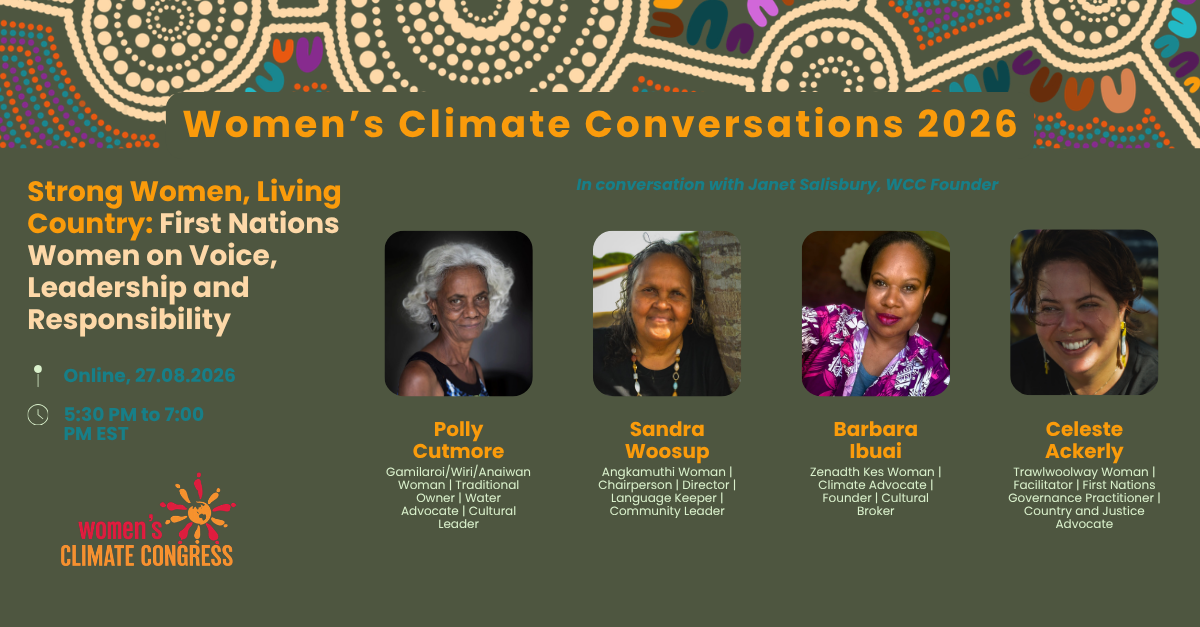
Strong Women, Living Country
First Nations Women's Voices in Leadership, Responsibility and Caring for Country
Thursday 27 August 2026
5.30 -7.00 pm AEST (Sydney, Canberra, Melbourne)
NEW! Listen to the 2-part podcast of this conversation on 3CR Community Radio Earth Matters (with many thanks to producer Rebecca Horridge):
Part 1: Strong Women, Living Country
Part 2: First Nations Women's Voices in Leadership, Responsibility and Caring for Country.
Meet our conversationalists …
Polly (Maria) Cutmore is a Gamilaroi/Wiri/Anaiwan woman and Traditional Owner from Moree in northern New South Wales. Her Country includes the Mehi River, which flows through Moree and joins the Gwydir River and the wetlands system to the south.
A cultural advocate since the 1980s, Polly became a Native Title Applicant in 2016 and challenged gas developer Santos in court. She has contributed to the Commonwealth Aboriginal Water Buyback Program and numerous water governance groups and committees, advocating for First Nations leadership in water management and cultural governance.
Through the Mehi Centre, which she convenes in Moree, Polly recently led the landmark Growing Up on the Mehi gathering, bringing together Aboriginal women from across the northern Murray–Darling Basin to share stories, strengthen connections, and develop the Moree Statement—a collective call to government for stronger recognition of First Nations authority, Country and water rights.
Passionate about self-determination, cultural authority and the protection of living rivers, Polly continues to advocate nationally and internationally for climate action, Aboriginal water rights and meaningful First Nations participation in decision-making.
Sandra Woosup is a respected Angkamuthi woman, community leader, language keeper and advocate whose work is grounded in cultural strength, self-determination and creating opportunities for her people.
Sandra is the Chairperson of the Angkamuthi Tribal Aboriginal Corporation and serves as a Director of both the Ely Bauxite Mine Beneficiary Trust and the Apudthama Land Trust. Through these roles, she contributes to important decisions relating to Country, community governance, economic opportunities and the protection of cultural and community interests.
Sandra is also one of the language keepers within her community and is actively involved in ongoing language maintenance work to revive and strengthen a sleeping language. Her work supports the continuation of culture, knowledge and identity for current and future generations. She also serves on the committee of Animal Management in Rural and Remote Indigenous Communities, supporting culturally appropriate and community-led approaches to animal health and wellbeing.
Sandra is passionate about strengthening the voices of Aboriginal women and supporting women-led projects that build confidence, connection and lasting change. Through initiatives such as women-led yarning circles on Country, she creates spaces where women can reconnect with culture, strengthen relationships, share knowledge and support one another. Her leadership reflects the strength of women working together to care for Country, uphold culture and create a stronger future for the next generation.
Barbara Ibuai is a Zenadth Kes (Torres Strait) climate advocate, Saibai Koedal woman, and founder of Climate Collective Zenadth Kes (CCZK) which is being built as a NFP NGO - a civil society response to climate adaptation in her region. Drawing on the cultural authority granted by Elders and her frontline experience, she began leading community driven climate resilience work in Zenadth Kes in April 2025.
A founding member of the Feminist Climate Collective (FeCC), along with Women's Climate Congress, CCZK works to advance climate leadership and Indigenous led solutions from her region. Beyond, CCZK's organisational reach already includes national campaigns such as She Powers in collaboration with 1 Million Women, and Make Big Polluters Pay Alliance with Bushfire Survivors for Climate Action (and over 30 co-collaboraters), demanding accountability from major emitters.
Barbara’s work blends policy, culture, and storytelling. She continues to elevate First Nations Climate Leadership and Women’s Climate Leadership on national and global stages, including most recently at Women Deliver 2026, UN Working Group SB64 in Bonn Germany (2026) where a positioning discussion paper and cultural diplomacy brief were submitted; COP29 (Azerbaijan) and COP30 (Belem) appearing as guest panelist advocating and speaking about the importance of country and connection.
Barbara’s professional background blends diplomacy, security, and climate governance, giving her a strong foundation for frontline advocacy. Her previous professional career includings working in the Australian Department of Foreign Affairs, Australian Maritime Border Enforcement, an Australian-led Pacific Peace Monitoring in Bouganiville Papua New Guinea, and the Torres Strait Regional Authority.
Celeste Ackerly is a proud Trawlwoolway woman from lutruwita (Tasmania) whose work sits at the intersection of First Nations leadership, governance, conservation and systems change.
With a background spanning Indigenous engagement, environmental governance and community-led collaboration, Celeste has worked alongside Traditional Owners, Aboriginal organisations and communities across Australia to support culturally informed approaches to conservation, policy and leadership. Her work has focused on strengthening Indigenous governance, embedding cultural authority within organisations, and creating spaces where First Nations voices can shape decisions that affect Country and community.
Celeste has also facilitated women's leadership initiatives and collaborative yarning spaces, believing that meaningful change begins with listening, relationships and shared responsibility. She is currently undertaking postgraduate studies in Policy and Governance, with a particular interest in how First Nations knowledge, governance systems and community leadership can better inform public policy and environmental decision-making.
As facilitator, Celeste brings together her professional experience and deep commitment to creating respectful conversations that centre First Nations voices, lived experience and the enduring relationship between people and Country.
Janet Salisbury is the Founder and Program Lead of the Women's Climate Congress, a national movement bringing together women from across Australia to create courageous conversations and collaborative action on climate, democracy and the future we share. Through Women's Climate Congress, Janet has spent many years creating spaces where diverse voices can come together, build relationships and explore solutions grounded in respect, inclusion and hope.
Women’s Climate Conversations archive
-

2026
March - Women coming together to activate the UNFCC Belem Gender Action Plan. With Fleur Newman, Joanne Crawford and Sally Box
-
2025
February - Partnership on climate between First Nations and settler women: Potential and opportunities. With Bec Blurton, Robyn James and Terri Reid
June - Compassion and kindness in government - a gateway to wise action on climate change and other challenges? With Jennifer Nadel, Chloë Spackman and Kate Chaney
-
2024
September - Women negotiating climate. With Dr Sally Box, Kesaya Baba and Tamara Inkster-Draper
July - Caring for future generations and all Earth life. With Susan Moylan-Coombs, Professor Susan Harris Rimmer and Dr Elise Stephenson
May - Gender, climate change and disaster risk. With Dr Mary Picard, Amanda Lamont, Professor Margaret Alston AM OAM and Toni Hassan
February - Women speak out on COP28. With Mamta Borgoyary, Angelica Mantikas, Tishiko King and Sarah Ransom
-

2023
September - Meeting the climate crisis inside out. With Jamie Bristow and Christine Wamsler
August - Women bringing new agendas to COP28. With Katrin Geyer, Anna Reynolds and Natalie Sifuma
July - The old world and the new: Women’s leadership journeys in a changing climate. With Cheryl Durrant, Gabrielle Kuiper and Willow Berzin
February - Women Speaking Out: The case of the Waratah Coal mine, climate change and human rights. With Alison Rose, Patricia Julien, Lala Gutchen and Murrawah Johnson
-

2022
June - Women call for unified national plan for action on climate. With Kerry Chikarovski and Cheryl Durrant
April - Women call for unified national plan for action on climate. With Helen Dalley Fisher and Sienna Aguilar
March - Changing Climates: Equality today for a sustainable tomorrow. With Victoria McKenzie and Dr Zohl dé Ishtar
February - What really counts? Women speaking out for change. With Jane Caro AM and Jane Gleeson-White
-

2021
October - After the pandemic. What happens next? And why is women's leadership is important? With Dr Emma Dawson and Professor Susan Harris Rimmer
September - With Associate Professor Melissa Hart and Dr Angela Maharaj
August - Listening to First Nations knowledge to inform Earth-centred, collaborative governance. With Dr Mary Graham and Dr Michelle Maloney
July - Women’s voices changing the public conversation on climate change. With Dr Rebecca Huntley and Dr Jonica Newby
June - Finding compassion in public discourse and policy making. With Dr Lynne Reeder and Revd Dr Sarah Bachelard
May - Listening as we go: connecting over shared values despite difference. With Millie Rooney and Julie Lyford OAM
April - Building a unified national agreement for Australia’s climate response. With Rhiân Williams and Val Lang AM
March - How can women’s leadership inspire collaborative national action on climate change? With Cristina Talacko and Dr Kim Loo.
-

2020
June - Talking together. Moderated by Lyn Stephens with Dr Janet Salisbury
May - Women turning the tide. Moderated by Lyn Stephens with Dr Janet Salisbury, Dr Honey Nelson and Louise Tarrant
May - About the Women’s Climate Congress. Moderated by Lyn Stephens with Dr Janet Salisbury